
Evaluation of computer-tailored motivational messaging in a health promotion context
Published in CONTEXT 2019 (Modeling and Using Context, LNCS), 2019
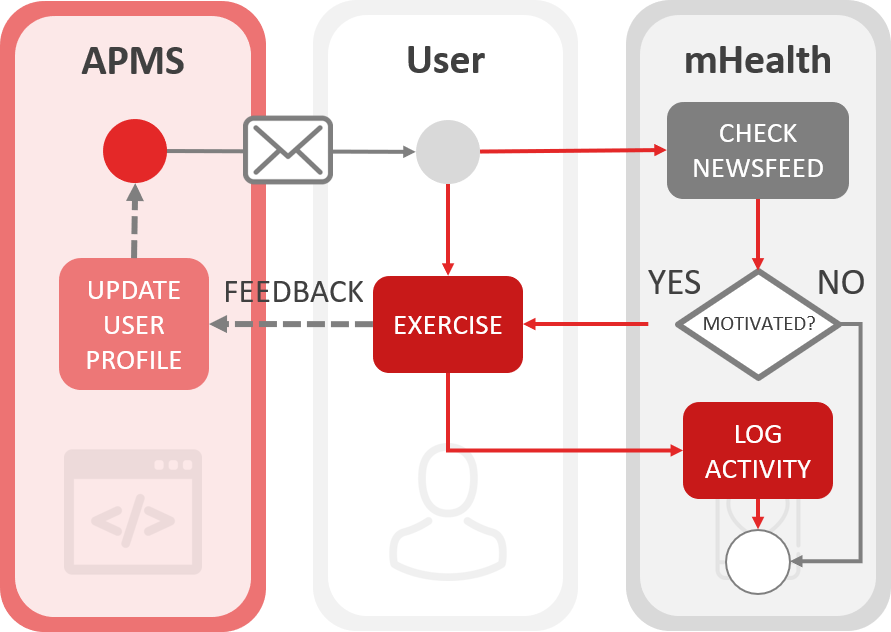
Persuasive messages have recently been shown to be more effective when tailored to the personality and preferences of the recipient. However, much of the literature on adaptive persuasion has evaluated the effectiveness of persuasive attempts by the direct reactions to those attempts instead of changes on the longer term (e.g. lifestyle changes). Results of this study suggest that adaptive persuasion improves attitudes towards persuasive attempts, but does not necessarily cause a change in longer term behavior. This was found through a randomized controlled trial evaluating the implementation an adaptive persuasive system in a health promotion intervention. This article provides a detailed description of this evaluation and encourages the research community to (1) become more skeptical towards the longer term effectiveness of adaptive persuasive techniques and (2) design more explicitly for longer term changes in behavior.
I presented this work at CONTEXT 2019 in Trento and, in short form, at the Eindhoven Data Science Summit 2019.
Recommended citation: d'Hondt, J.E., Nuijten, R.C.Y., Van Gorp, P.M.E. (2019). Evaluation of Computer-Tailored Motivational Messaging in a Health Promotion Context. In: Bella, G., Bouquet, P. (eds) Modeling and Using Context. CONTEXT 2019. LNCS 11939, pp. 120–133.
Download Paper | Download Slides